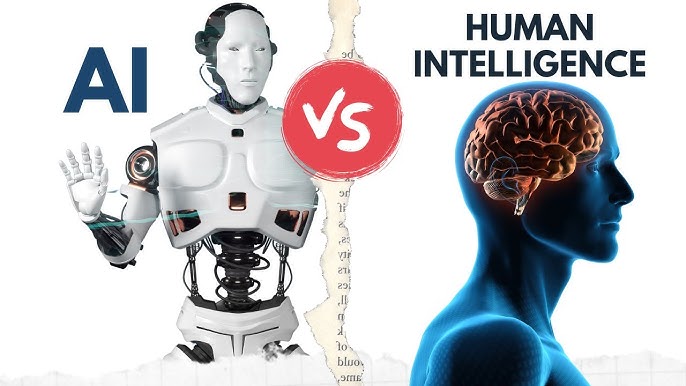
Artificial Intelligence (AI) is transforming industries and everyday life. However, many people still wonder how AI compares to human intelligence. While AI performs specific tasks with incredible speed, human intelligence remains unmatched in creativity, emotions, and critical thinking. Therefore, understanding their differences helps individuals and businesses use AI more effectively.
What Is Artificial Intelligence?
Artificial Intelligence refers to computer systems designed to perform tasks that typically require human intelligence. These tasks include learning, reasoning, problem-solving, language understanding, and decision-making.
Moreover, AI improves through machine learning algorithms and large datasets. Consequently, AI systems become more accurate as they process additional information.
What Is Human Intelligence?
Human intelligence is the natural ability to think, learn, reason, create, and adapt. Unlike AI, humans understand emotions, values, ethics, and social interactions.
Furthermore, people can solve unfamiliar problems using intuition and experience. As a result, human intelligence remains highly flexible and adaptable.
Key Differences Between AI and Human Intelligence
Learning Ability
AI learns from data, patterns, and algorithms. However, it depends on the quality and quantity of available information.
Humans learn through education, observation, emotions, and personal experiences. Therefore, they adapt more naturally to unexpected situations.
Creativity
AI can generate images, music, articles, and code based on existing patterns. Nevertheless, it lacks genuine imagination and original inspiration.
Humans create innovative ideas through emotions, curiosity, and life experiences. Consequently, creativity remains a uniquely human strength.
Decision-Making
AI analyzes massive amounts of data within seconds. Therefore, it often makes faster decisions than humans.
However, people consider ethics, empathy, and social values before making important decisions. As a result, human judgment remains essential in complex situations.
Emotional Intelligence
Artificial Intelligence cannot genuinely experience emotions. Instead, it recognizes emotional patterns through data analysis.
Humans naturally understand feelings, relationships, and empathy. Therefore, emotional intelligence plays a vital role in leadership, communication, and teamwork.
Problem-Solving Skills
AI excels at solving structured and data-driven problems. Moreover, it delivers consistent performance without fatigue.
Humans solve both structured and unstructured problems creatively. Consequently, they handle uncertainty more effectively than AI.
Advantages of Artificial Intelligence
Artificial Intelligence offers several important benefits.
- Processes large datasets quickly.
- Works continuously without fatigue.
- Reduces repetitive manual tasks.
- Improves business efficiency.
- Supports accurate data analysis.
- Enhances customer service.
- Assists medical diagnosis and research.
Therefore, AI has become an essential technology across many industries.
Advantages of Human Intelligence
Human intelligence provides strengths that AI cannot fully replicate.
- Creative thinking.
- Emotional understanding.
- Ethical decision-making.
- Adaptability.
- Strong communication skills.
- Leadership abilities.
- Critical thinking.
These qualities make humans indispensable in many professions.
Can AI Replace Human Intelligence?
AI continues to automate repetitive and data-intensive tasks. However, it cannot fully replace human intelligence.
People possess creativity, empathy, moral judgment, and emotional awareness. Moreover, humans build meaningful relationships and inspire innovation. Therefore, AI should complement human abilities rather than replace them.
AI and Humans Working Together
The future depends on collaboration between Artificial Intelligence and human intelligence. AI handles repetitive processes while humans focus on creativity and strategic thinking.
For example, doctors use AI to analyze medical images. Meanwhile, they rely on experience and compassion when treating patients. Similarly, businesses use AI for analytics while leaders make final strategic decisions.
Consequently, combining AI with human expertise produces better outcomes than either working alone.
Challenges of Artificial Intelligence
Despite its advantages, AI presents several challenges.
- Data privacy concerns.
- Algorithm bias.
- Security risks.
- Limited emotional understanding.
- Ethical considerations.
- Dependence on quality data.
Therefore, responsible AI development remains essential for long-term success.
The Future of AI and Human Intelligence
Artificial Intelligence will continue improving rapidly. However, human intelligence will remain the foundation of innovation, leadership, and creativity.
Moreover, future workplaces will combine AI-powered automation with human expertise. As a result, organizations will achieve higher productivity while preserving the value of human decision-making.
Conclusion
The comparison between AI and human intelligence highlights their unique strengths. AI delivers speed, efficiency, and powerful data analysis. Meanwhile, humans contribute creativity, empathy, ethics, and adaptability.
Instead of competing, AI and humans will work together to solve complex challenges. Therefore, understanding both forms of intelligence will help individuals and businesses thrive in the digital age.